
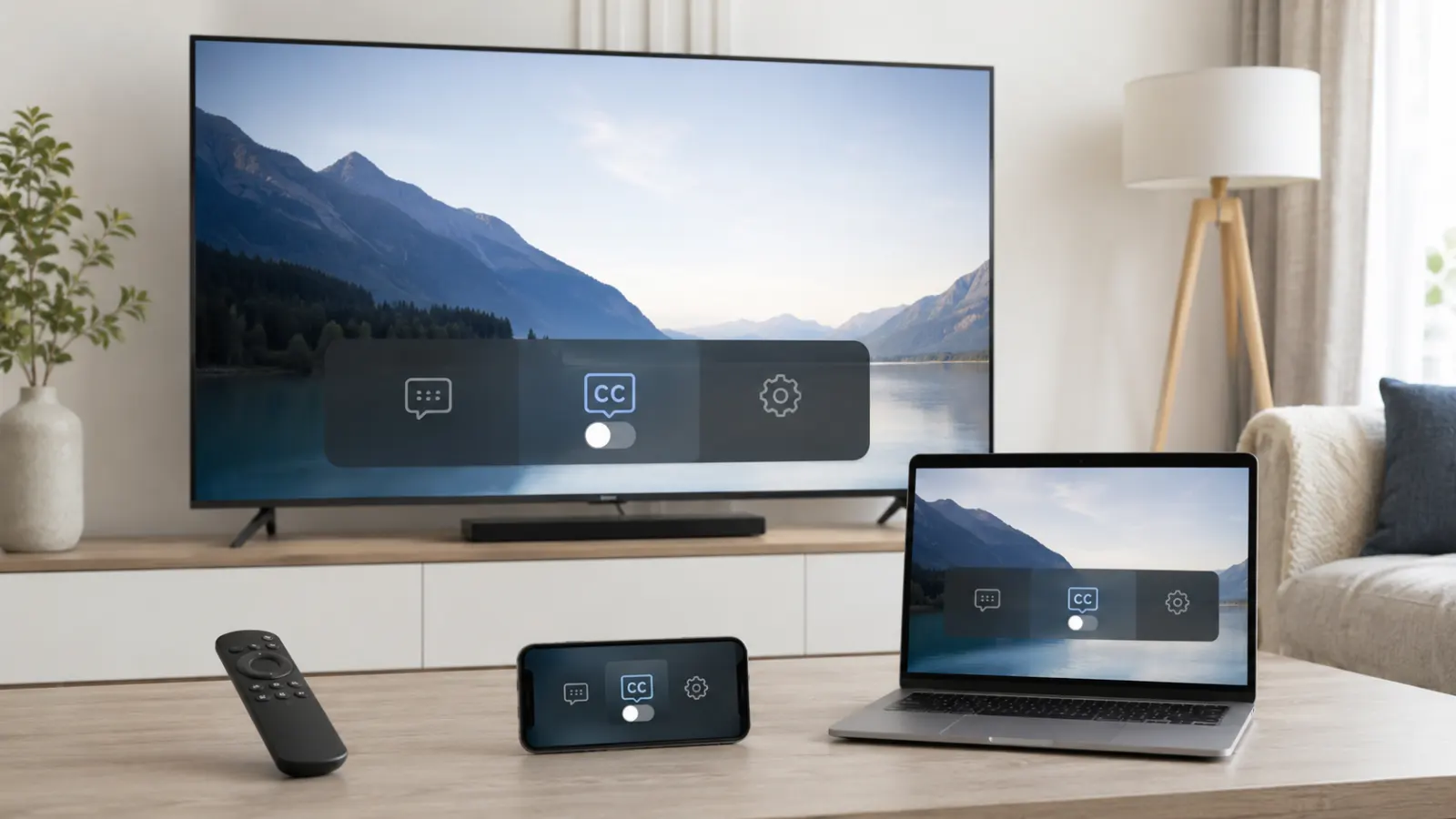
Closed captions help viewers follow dialogue, identify speakers, and understand important sounds. However, you may want to remove them when they cover part of the screen, appear unexpectedly, or duplicate subtitles already built into a video.
To turn closed captioning off, open the video player’s audio, subtitle, or accessibility menu and select Off, None, or Captions Off. If the text remains, check the caption settings on your TV, streaming device, phone, computer, or cable box.
This guide explains how to turn closed captioning off across popular TVs, streaming services, mobile devices, computers, and video platforms.
Quick Answer: How Do You Turn Closed Captioning Off?
Try these steps first:
- Start playing the video.
- Tap the screen or press the menu, options, up, or down button on your remote.
- Open Audio and Subtitles, Subtitles, CC, or Accessibility.
- Select Off, None, or Captions Off.
- Resume the video and check whether the text has disappeared.
If captions remain visible, turn them off in the device settings as well as the streaming app.
Closed Captions, Subtitles, and Open Captions
Knowing which type of text appears on your screen can help you find the correct setting.
Closed captions
Closed captions usually display spoken dialogue along with relevant sounds, music cues, and speaker identification. Viewers can normally turn them on or off.
Subtitles
Subtitles primarily show spoken dialogue. They often translate speech into another language, although same-language subtitles are also common.
Open captions
Open captions form part of the video itself. You cannot remove them through the playback or accessibility settings because the creator permanently added them to the picture.
Samsung’s accessibility guidance confirms that viewers can switch closed captions on or off, while open captions inserted into the content cannot be disabled. Samsung Support
Live captions
Some phones and computers can automatically create captions for audio playing on the device. These captions may appear even when subtitles inside the video app are off.
Turn Closed Captioning Off on a Smart TV
Smart TVs can receive captions from several places, including:
- The television’s accessibility settings
- A streaming app
- A cable or satellite box
- A connected Roku, Fire TV, or Apple TV device
- Captions permanently included in the program
First, turn captions off inside the app you are watching. If they remain, check the television settings.
Common smart TV steps include:
- Press Home or Settings on the remote.
- Open Accessibility, General, or System.
- Select Caption Settings, Closed Captions, or Subtitles.
- Change the caption setting to Off.
Menu names vary by television brand, model, region, and software version.
How to Turn Off Closed Captions on a Samsung TV
On supported Samsung Smart TVs:
- Press the Home button.
- Open Settings.
- Select General.
- Choose Accessibility.
- Open Caption Settings.
- Select Caption to switch it off.
Samsung also provides an Accessibility Shortcuts menu on supported remotes. The company notes that the available settings can depend on the broadcast and television model.
If captions remain after you switch this setting off, check the streaming app or connected device.
How to Turn Closed Captioning Off on Roku
Roku lets you manage captions through the main settings menu or during playback.
Turn Roku captions off through Settings
- Press Home on the Roku remote.
- Select Settings.
- Open Accessibility.
- Select Captions mode.
- Choose Off.
On some Roku devices, Captions appears directly in Settings instead of under Accessibility.
Turn Roku captions off while watching
- Start playing the program.
- Press the Star button on the Roku remote.
- Select Closed captioning.
- Choose Off.
Roku explains that some streaming services use their own caption controls. If the Roku setting does not remove the text, open the caption menu inside the app.
How to Turn Closed Captioning Off on Fire TV
For supported Fire TV content:
- Start playing the video.
- Press the Menu button on the Fire TV remote.
- Select Subtitles.
- Choose Off under Subtitles.
Amazon notes that the exact on-screen options can depend on the app and the content being played. Amazon Fire TV Help
If the text appears inside only one streaming app, change the subtitle setting within that app.
How to Turn Closed Captions Off on Apple TV
You can change captions during playback or adjust the Apple TV accessibility preference.
During video playback
- Start the video.
- Open the playback controls.
- Select the Subtitles or Audio and Subtitles button.
- Choose Off.
In Apple TV settings
- Open Settings.
- Select Accessibility.
- Choose Subtitles and Captioning.
- Switch off Closed Captions and SDH.
Apple TV can also show automatic subtitles after you mute the sound or skip backward, depending on your settings. You can review these options under Settings, Video and Audio, and Automatic Subtitles.
How to Turn Closed Captioning Off on Netflix
Netflix manages subtitles and closed captions from the playback menu.
- Open Netflix and play a movie or episode.
- Pause the video.
- Tap or click the screen on a phone, tablet, or computer.
- On a TV, press the up or down arrow on the remote.
- Select Audio & Subtitles.
- Choose Off under the subtitle options.
- Resume the video.
Netflix notes that some foreign-language dialogue may still receive subtitles even when your regular subtitle preference is off.
If Netflix subtitles will not turn off
Try these checks:
- Confirm that Off is selected inside Netflix.
- Turn off captions in your television or streaming device settings.
- Switch to another Netflix profile and then return to your original profile.
- Close and reopen the Netflix app.
- Restart the streaming device.
- Test a different movie or episode.
Captions that remain on only during particular scenes may be forced subtitles supplied with the program.
How to Turn Closed Captions Off on YouTube
On a computer
- Play a YouTube video.
- Click the CC button at the bottom of the player.
- If needed, open Settings.
- Select Subtitles/CC.
- Choose Off.
Clicking the CC button again switches captions off.
You can also use the C key while the video player is active to toggle captions on or off.
On an iPhone, iPad, or Android device
- Tap the video to reveal the controls.
- Tap the CC button.
- If no CC button appears, open the settings menu.
- Select Captions.
- Choose Off.
YouTube states that the CC button may not appear when captions are unavailable for a particular video.
On a smart TV or game console
- Start the video.
- Open the player controls.
- Select CC or Captions.
- Choose Off.
If captions return on new videos, check the accessibility or caption preferences on the TV or streaming device.
How to Turn Closed Captioning Off on Prime Video
During playback on a supported device:
- Start the movie or episode.
- Open the playback controls.
- Select the Closed Caption or Subtitles icon.
- Choose Off.
Amazon confirms that the caption or subtitle icon appears in the playback menu when the title supports the feature.
If Prime Video captions remain visible, also inspect the accessibility settings on the Fire TV, smart TV, phone, or other playback device.
Turn Closed Captioning Off on an iPhone or iPad
Inside a video app
- Play the video.
- Tap the screen.
- Open the subtitle or audio menu.
- Select Off.
In iPhone or iPad settings
- Open Settings.
- Select Accessibility.
- Tap Subtitles & Captioning.
- Turn off Closed Captions + SDH.
This setting controls the preference for closed captions and subtitles for deaf and hard-of-hearing viewers in supported apps.
Turning off the system preference may not remove subtitles selected separately inside an app.
Turn Live Caption Off on an Android Phone
Android’s Live Caption feature automatically converts speech from supported media and calls into text. It is separate from captions supplied by YouTube, Netflix, or another app.
A common method is:
- Press a volume button.
- Find the Live Caption icon in the volume panel.
- Tap the icon to switch Live Caption off.
You may also find Live Caption in the device’s Quick Settings or Accessibility settings. Google notes that Android menu steps can vary by device. Its accessibility documentation describes Live Caption as a feature that automatically captions speech playing on the device.
If captions appear in only one app, use that app’s CC or subtitle control instead.
Turn Closed Captioning Off on Windows
Windows 11 includes Live Captions, which can caption audio playing on the computer.
To turn the feature off:
- Open Settings.
- Select Accessibility.
- Choose Captions.
- Switch Live captions off.
You can also open Quick Settings from the taskbar, select Accessibility, and switch off Live captions.
The Windows key + Ctrl + L shortcut toggles Live Captions. If you press it accidentally, the caption window may appear again.
If captions appear only in a browser video, turn them off in the website’s player rather than in Windows.
Turn Closed Captions Off on a Mac
Turn off the Mac caption preference
- Open the Apple menu.
- Select System Settings.
- Choose Accessibility.
- Open Captions.
- Turn off Prefer closed captions and SDH.
Apple explains that this preference requests closed captions and SDH when supported by the content or app.
For captions selected inside Netflix, YouTube, or another service, use the controls in that video player as well.
Turn Live Captions Off in Microsoft Teams
During a Teams meeting:
- Select More options in the meeting controls.
- Choose Turn off live captions.
Microsoft states that meeting captions are visible to the person who enables them and can be switched off from the meeting controls.
Turning off your captions does not necessarily change another participant’s individual caption setting.
Why Closed Captions May Keep Turning Back On
Captions can return even after you switch them off. The most common causes involve separate settings at different levels.
The app and device have different settings
A streaming app can have captions off while your TV or streaming device still has them on. The reverse can also happen.
Check both locations:
- The app’s playback menu
- The device’s accessibility menu
Profile preferences are being restored
Some streaming services save language and subtitle choices to a user profile. Switching profiles can load a different preference.
The video includes forced subtitles
A program may display subtitles during foreign-language dialogue, fictional languages, translations, or scenes where the viewer needs written information. Netflix specifically notes that this text may appear even when regular subtitles are off.
The captions are part of the video
If the uploader embedded the words into the image, they are open captions. Playback settings cannot remove them.
Live Caption is active on the device
Android phones and Windows computers can generate captions independently of the app. Turning off CC inside the player will not disable the device’s Live Caption feature.
A cable box controls the captions
Your television setting may not control captions generated by a cable or satellite receiver. Open the receiver’s accessibility, language, or display menu and switch closed captioning off there.
An accessibility shortcut was pressed
Remote buttons and keyboard shortcuts can activate captions quickly. Check whether a CC, subtitle, accessibility, or Live Caption shortcut was pressed accidentally.
What to Do When Captions Will Not Turn Off
Work through these steps in order:
- Turn captions off in the video player.
- Check the app’s subtitle settings.
- Turn captions off in the TV or device accessibility settings.
- Check a connected cable box, streaming stick, or game console.
- Close and reopen the app.
- Restart the device.
- Play a different title to see whether the issue affects all content.
- Update the app and device software through their normal update menus.
- Confirm whether the captions are permanently embedded in the video.
Avoid resetting the entire device until you have checked every caption source. A factory reset removes settings and may require you to sign in and configure the device again.
How to Identify Where the Captions Come From
Look at when and where the text appears.
- Only one video: The captions may be embedded or forced.
- Only one app: Check that app’s subtitle settings.
- Every app: Check the TV, phone, computer, or streaming-device accessibility settings.
- Only live television: Check the TV tuner, cable box, or satellite receiver.
- Text appears over all audio: Look for Android Live Caption or Windows Live Captions.
- Two sets of captions appear: Both the app and device may have captions enabled.
This quick test can save time because it reveals which layer controls the text.
When You May Want to Keep Captions Available
Turning captions off does not mean you need to disable every caption preference permanently. You can reactivate them when:
- You cannot hear the dialogue clearly.
- You are watching in a noisy room.
- You need to keep the volume low.
- A speaker has an unfamiliar accent.
- You are learning another language.
- The program contains important sound information.
- Someone watching with you is deaf or hard of hearing.
Closed captions often include sound descriptions and speaker labels that ordinary subtitles may omit. Netflix distinguishes subtitles from closed captions by explaining that closed captions can include dialogue and descriptions of relevant sounds.
Common Mistakes to Avoid
Changing caption style instead of switching captions off
Font, color, size, and background controls only change how captions look. Find the main caption toggle and select Off.
Checking only the television
The app, streaming stick, or cable box may generate the captions.
Confusing captions with audio description
Audio description is spoken narration that explains visual action. It uses a separate audio or accessibility setting.
Assuming all on-screen text is optional
Creators sometimes add text permanently to a video. No device setting can remove that text.
Turning off all accessibility settings
You only need to change the relevant caption control. Other accessibility tools may be useful to you or another person using the device.
Final Takeaway
To turn closed captioning off, start with the CC, subtitle, or audio menu inside the video player. If the captions remain, check your TV, streaming device, phone, computer, cable box, and accessibility settings.
Captions that appear in only one scene or video may be forced subtitles or open captions. Those cannot always be removed. Identifying where the text comes from is the fastest way to find the correct control.
Frequently Asked Questions
How do I get closed captioning off my TV?
Press Home or Settings on the remote, open Accessibility or Caption Settings, and switch Caption or Closed Captioning to Off. If the text remains, check the streaming app and connected cable or streaming device.
Why are closed captions showing when CC is off?
The captions may come from another device, a streaming app, a system-level Live Caption feature, or the video itself. Check each source separately.
What button turns off closed captioning?
Many video players use a CC button. TV remotes may include a CC, Subtitle, Menu, Options, or accessibility button. Pressing the same CC control often toggles captions off.
Can I permanently turn off closed captions?
You can disable the caption preference in many device accessibility menus, but individual apps, profiles, forced subtitles, or embedded text may still display words in certain content.
Why does Netflix still show subtitles after I turn them off?
Netflix may show subtitles for foreign-language dialogue even when the standard subtitle preference is off. The text may also come from the device rather than Netflix.
Why does YouTube keep turning captions on?
Check both the CC control in the YouTube player and the caption or accessibility settings on your device. Browser preferences, account settings, and device-level captions can affect what appears.
How do I remove captions that are built into a video?
You generally cannot remove open captions through normal playback settings because they form part of the video image. You would need a different version of the video without embedded captions.
Are closed captions the same as subtitles?
Not exactly. Subtitles usually communicate dialogue, while closed captions may also identify speakers and describe sounds. Platforms sometimes use the labels interchangeably in their menus.
1 thought on “How to Turn Closed Captioning Off on Any Device”